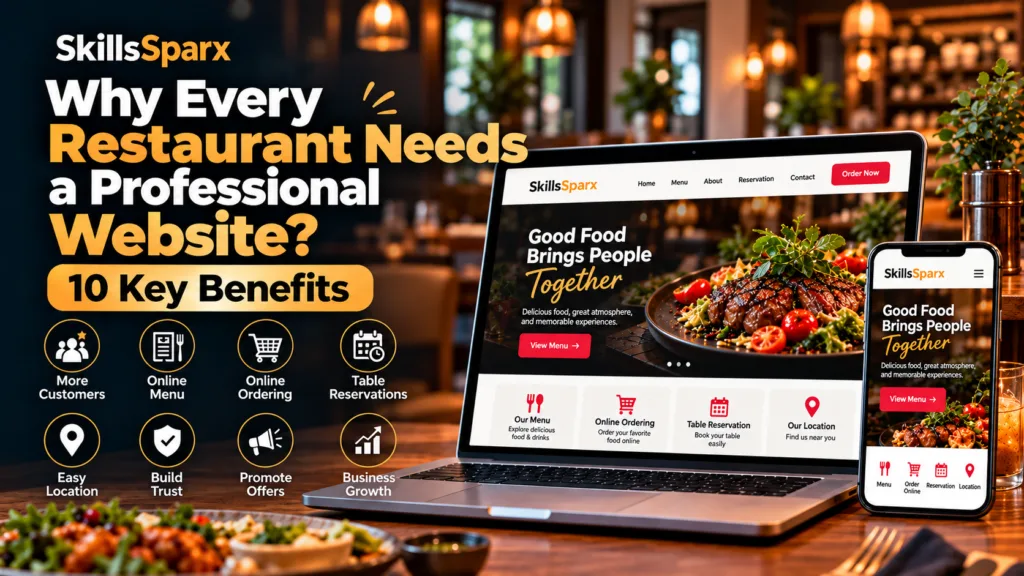
Running a restaurant is not only about serving great food. Today, customers also want to find your restaurant online, check the menu, see the location, read reviews, and learn about your services before they visit.
A professional restaurant website gives your business a reliable online presence and makes it easier for potential customers to discover and connect with you. Whether you run a small café, local restaurant, fast-food business, or large dining establishment, a well-designed website can support your marketing and business growth.
In this guide, we will discuss 10 important reasons why every restaurant needs a professional website and what your website should include.
What Is a Restaurant Website?
A restaurant website is an online platform where customers can find important information about your restaurant. It can include your menu, opening hours, location, contact details, food images, online ordering, table reservations, and other useful information.
Unlike social media profiles, a website gives your restaurant a dedicated online space that you control.
Why Does Every Restaurant Need a Professional Website?
A professional website can help restaurants present their services, menu, ordering options, and business information in one place. Businesses looking for a complete online solution can explore our web development services to find website solutions based on their specific requirements.
1. Build a Professional Online Presence
Customers often search online before deciding where to eat. A professional website helps your restaurant establish a strong online presence.
Your website can display your restaurant name, logo, menu, food images, location, opening hours, and other important information in one place.
A well-designed website can also create a more professional impression than relying only on a social media page.
2. Help Customers Find Your Restaurant
One of the biggest benefits of having a restaurant website is that customers can find information about your business through search engines.
When your website is properly optimized for SEO, it can appear when people search for relevant restaurant-related terms.
For example, customers may search for:
- Restaurants near me
- Best restaurants in [city]
- Italian restaurant in [city]
- Family restaurant in [city]
- Restaurant with online ordering
A properly optimized website can help your business become more visible to potential customers.
3. Display Your Menu Online
Customers want to know what food you offer before visiting a restaurant.
Your website can provide a complete online menu with:
- Food names
- Descriptions
- Prices
- Food images
- Special offers
- Available meal options
- Drinks and desserts
Keeping the menu on your website also makes it easier for customers to check your offerings before they decide to visit or order.
4. Make Online Ordering Easier
A restaurant can use its website to provide online ordering options.
Customers can browse the menu, select their preferred items, provide their information, and place an order online when the necessary ordering functionality is available.
An online ordering system can make the customer experience more convenient and can help restaurants manage orders more efficiently.
5. Offer Online Table Reservations
Another useful feature of a restaurant website is online table reservation.
Instead of calling the restaurant, customers can use an online reservation system to request a table.
A reservation feature can be particularly useful for:
- Family restaurants
- Fine-dining restaurants
- Cafés
- Large restaurants
- Restaurants that receive many bookings
This makes the process easier for both customers and restaurant staff.
6. Show Location, Opening Hours, and Contact Information
Customers need basic information before visiting a restaurant.
Your website should clearly display:
- Restaurant address
- Phone number
- Opening hours
- Email address
- Location/map
- Social media profiles
This information should be easy to find on both desktop and mobile devices.
Adding accurate location information can also support local SEO and help customers find your physical restaurant.
7. Build Customer Trust
A professional online presence can help a restaurant appear more trustworthy.
Your website can show:
- Restaurant history
- Food quality information
- Professional food photography
- Customer testimonials
- Awards or achievements
- Restaurant team information
- Contact details
When customers can easily find reliable information about your business, they may feel more confident about choosing your restaurant.
8. Promote Special Offers and Events
Restaurants frequently run promotions, discounts, seasonal menus, and special events.
A restaurant website gives you a place to promote these offers.
For example, you could create sections for:
- Weekend offers
- Lunch deals
- Family packages
- Seasonal menus
- Holiday promotions
- Special events
- New dishes
This allows customers to see your latest offers whenever they visit your website.
9. Reach Customers Beyond Social Media
Social media is useful for restaurants, but it should not be your only online presence.
Social media platforms can change their algorithms, features, and rules. Your website gives your restaurant a dedicated online platform that you control.
You can also connect your social media profiles to your website so customers can easily move between your website and social channels.
For businesses looking for a complete online solution, professional web development services can help create a website based on specific business requirements.
10. Support Long-Term Business Growth
A professional website can become an important part of your restaurant’s digital marketing strategy.
As your business grows, you can add new features such as:
- Online ordering
- Table reservations
- Customer accounts
- Online payments
- Blog content
- Loyalty programs
- Gift cards
- Restaurant promotions
This means your website can grow along with your business instead of remaining a simple information page.
What Should a Restaurant Website Include?
A professional restaurant website should provide customers with the information and functionality they need.
Some essential elements include:
Attractive Homepage
Your homepage should quickly communicate what your restaurant offers and encourage visitors to explore your menu, make a reservation, or contact you.
Online Menu
Your menu should be easy to read and should include accurate prices and descriptions.
Food Images
High-quality food images can make your website more attractive and help customers understand what you offer.
Contact Information
Make your phone number, address, email, and other contact information easy to find.
Mobile-Friendly Design
Many customers search for restaurants using smartphones. Your website should work properly on mobile devices.
Online Booking or Ordering
Depending on your business model, you can provide table reservations or online food ordering.
Google Maps or Location Information
Make it easy for customers to find your physical location.
Restaurant Website Design Matters
A website should be designed according to the restaurant’s brand and target audience. To see examples of different website projects, you can explore our web development portfolio and see how websites can be created for different business requirements.
A website is not only about having information online. Restaurant website design also plays an important role in the customer experience.
The design should be:
- Clean and professional
- Easy to navigate
- Mobile-friendly
- Fast-loading
- Visually attractive
- Easy to read
- Consistent with the restaurant’s branding
For example, a restaurant specializing in fine dining may want an elegant design, while a fast-food restaurant may prefer a more energetic and modern appearance.
The design should match the restaurant’s brand and target audience.
How to Create a Restaurant Website
Creating a professional website starts with understanding the restaurant’s goals.
A basic process can include:
- Define the website goals.
- Plan the required pages and features.
- Choose a suitable design.
- Create the website structure.
- Add menu and restaurant information.
- Add images and important business details.
- Implement ordering or reservation functionality if required.
- Optimize the website for search engines.
- Test the website on mobile and desktop.
- Launch and maintain the website.
If you want to understand the broader development workflow, you can also explore the WordPress website development process.
How SEO Can Help a Restaurant Website
SEO can help your website become more visible in search engines.
Important restaurant SEO activities can include:
- Keyword research
- Local SEO
- Optimizing page titles
- Writing useful content
- Optimizing images
- Improving website speed
- Adding internal links
- Optimizing location information
- Creating useful blog content
For example, a restaurant in Lahore could create pages or content targeting relevant searches such as restaurant-related services in Lahore.
A well-optimized website can support your restaurant’s visibility when potential customers are searching online.
Restaurant Website vs Social Media
Social media and a website can work together rather than replacing one another.
Social media can help restaurants:
- Share food images
- Engage with customers
- Promote offers
- Publish updates
A website can provide:
- Complete menu
- Restaurant information
- Online ordering
- Reservations
- Location
- Business information
- SEO visibility
Using both can create a stronger online presence.
Final Thoughts
A professional restaurant website can do much more than simply display your restaurant’s name and contact information. It can help customers discover your business, view your menu, make reservations, place orders, learn about your services, and connect with your restaurant.
For restaurants that want to build a stronger digital presence, investing in a professional website can be an important step toward long-term online growth.
Whether you run a small café, local restaurant, or growing food business, the right website can provide a foundation for your digital marketing and customer experience.
Choosing the right website solution depends on your restaurant’s goals, audience, and required features. At SkillsSparx, we help businesses create professional websites and online solutions based on their specific needs.
If you want to see examples of different website projects, you can explore our web development portfolio and learn more about how professional websites can be built for different business needs.
If you are planning a professional website for your restaurant and need help deciding which features to include, you can contact our team to discuss your website requirements and business goals.
Whether you run a small café, local restaurant, or growing food business, the right website can provide a strong foundation for your digital presence. SkillsSparx can help businesses build professional website solutions tailored to their goals.
Frequently Asked Questions
Why does every restaurant need a website?
A restaurant needs a website to provide customers with important information such as its menu, location, opening hours, contact details, reservations, and online ordering options.
What should a restaurant website include?
Some restaurants may need functionality that is not available through standard website features. In such cases, custom plugins can be used to add specific functionality according to the business requirements.
How can a restaurant website help a business?
A restaurant website can help a business improve its online presence, make information easier to find, support local SEO, build customer trust, and provide online ordering or reservation options.
Is restaurant website design important?
Yes. Good restaurant website design can improve navigation, readability, mobile usability, and the overall customer experience.
How can I create a restaurant website?
You can create a restaurant website by planning its goals and features, choosing a suitable platform and design, adding restaurant information, implementing required functionality, optimizing it for SEO, and testing it before launch.