Last updated: October 2026
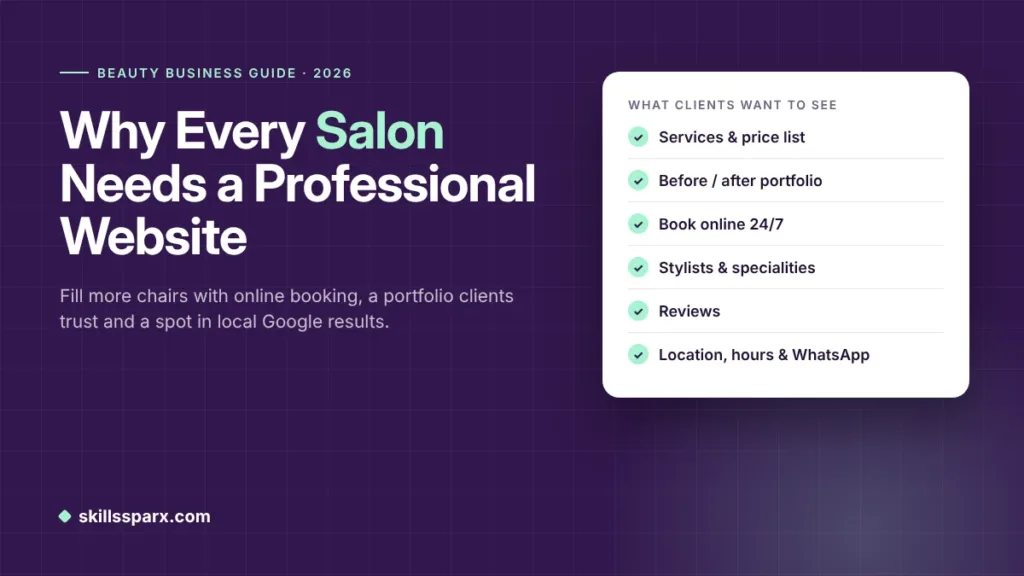
Quick answer: Every salon needs a professional website because clients check services, prices, photos of your work and reviews before they book, and many prefer to book online instead of calling. A good salon website shows your services and prices clearly, lets clients book appointments 24/7, showcases your portfolio, builds trust with real reviews and helps you appear when people search “salon near me”.
Running a salon, you know how much time goes into answering the same messages: “How much is a keratin treatment?”, “Do you have a slot on Saturday?”, “Where exactly are you?” Each one is a potential client, but answering them one by one in between appointments is exhausting, and slow replies lose bookings.
A salon website handles those questions for you, and fills your diary while you’re busy with clients. Here’s why it matters and what it should include.
Key takeaways
- Clients research and compare salons online before booking.
- Online booking fills slots after hours and cuts back-and-forth messages.
- Your own before-and-after photos are your most persuasive marketing.
- Clear price lists reduce hesitation and repeat questions.
- Instagram is great for inspiration, but a website is what ranks on Google and takes bookings.
14 reasons every salon needs a professional website
1. A professional first impression
A clean, well-designed website tells new clients you take your business seriously. It sets expectations for the experience before they even walk in.
2. More new clients
People new to the area, visitors and anyone who hasn’t found you on social media can discover you through search and Maps.
3. Better Google visibility
Searches like “hair salon in DHA”, “bridal makeup Lahore” or “nail salon near me” happen every day. A website with service pages and a strong Google Business Profile gives you a real chance to appear. Our local SEO guide shows how.
4. Services and prices, clearly laid out
Group services into categories like hair, colour, skin, nails, bridal and men’s, with “from” prices and typical durations. Clients who know roughly what they’ll pay are far more likely to book.
5. Online booking, around the clock
This is the biggest win for most salons. Clients pick a service, a stylist and a time, and you get the booking without a single phone call.

Automatic reminders by SMS or WhatsApp reduce no-shows, and an optional deposit for long services like bridal makeup or colour protects your time.
6. A portfolio that sells for you
Before-and-after photos of your own work are the most convincing thing on a salon website. Keep the lighting and angles consistent, group photos by service, and always get client permission before posting.
7. Trust and credibility
Stylist profiles, years of experience, product brands you use, hygiene standards and genuine Google reviews all help a first-time client feel comfortable choosing you.
8. Stronger local SEO
Mention your area naturally, keep your name, address and phone identical everywhere, embed a map and ask happy clients for reviews. These are the signals that move you up in local results.
9. Promote offers and packages
Bridal packages, Eid deals, student discounts, loyalty offers. Give each one a page with details and a booking button, then share that link on Instagram and WhatsApp.
10. Connect your social media
Instagram shows off your style. Your website converts it. Link your bio straight to your booking page and embed your Instagram feed so the site always feels fresh.
11. Information available 24/7
Hours, location, parking, price list and cancellation policy are all available whenever clients are planning, usually in the evening, when you’re closed.
12. Stand out from other salons
A specialist in curly hair, an organic skincare studio, a luxury bridal salon: your website lets you explain what makes you different, instead of competing only on price.
13. Measure your marketing
See which services get the most views and bookings, and which channels (Google, Instagram, ads) bring in clients. Then spend your time and budget where it works.
14. Room to grow
Add gift vouchers, an online shop for hair and skincare products, a second branch or training courses later, without starting over.
Essential features of a salon website
- Mobile-first design. Most clients book on their phones
- Fast-loading, compressed gallery images
- Sticky “Book now” and WhatsApp buttons
- Clear cancellation and late-arrival policy
- HTTPS and secure payments if you take deposits
Common salon website mistakes
- Price list only as a photo of the paper menu
- Stock photos instead of your own work
- Booking only by phone or DM
- Opening hours that don’t match Google
- Huge image galleries that make the site slow
- Posting client photos without permission
Getting your salon website built
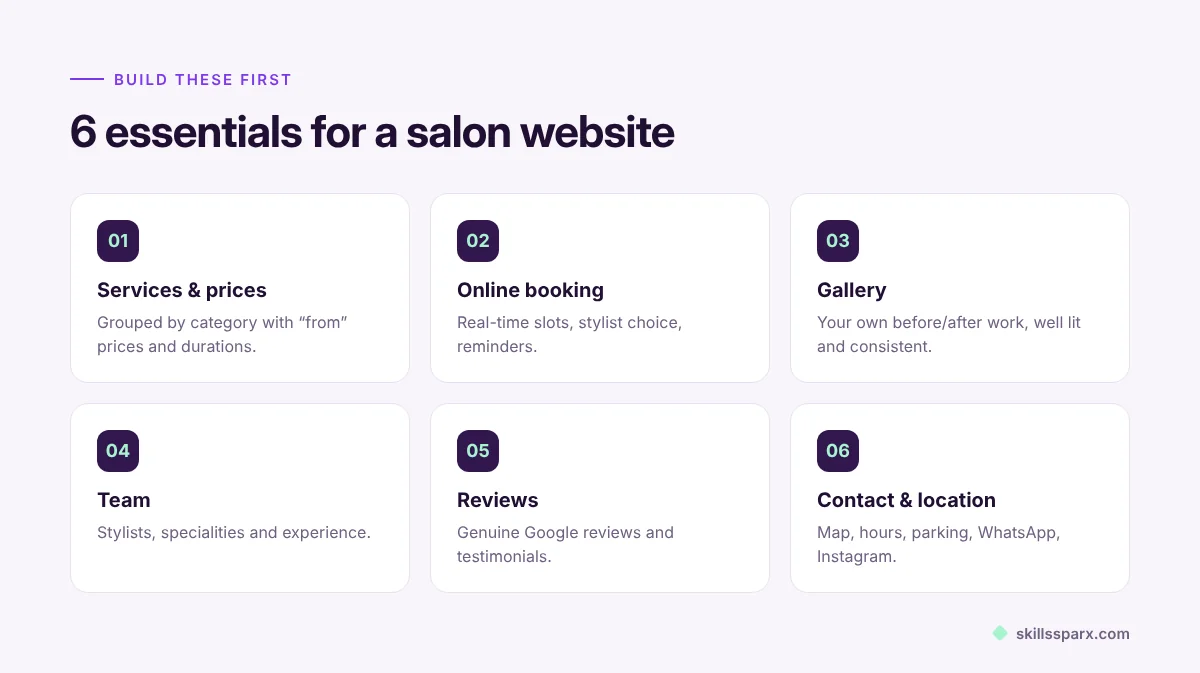
Start by listing your services and prices, collecting your best portfolio photos and choosing a booking tool that fits how your salon runs. Then build a simple, mobile-first site around the six essentials above. Our guide to website design and development explains each step, and our WordPress website cost guide helps with budgeting.
Final thoughts
A salon website works like a receptionist who never takes a break. It answers pricing questions, shows off your best work and books appointments while you focus on clients. Keep your prices, photos and hours current, make booking effortless, and your website will keep your chairs full.
Ready for a salon website that brings in bookings? See our web design services, browse our portfolio, or contact SkillsSparx.
Frequently asked questions
Why does a salon need a website?
Clients research salons online before booking. A website shows your services, prices and portfolio, builds trust with reviews, lets clients book online 24/7 and helps you appear in local Google searches.
Is Instagram enough for a salon?
Instagram is excellent for showing your work, but it is hard to compare prices and book there, and posts rarely rank on Google. Use Instagram for inspiration and a website for information and bookings.
Should a salon website have online booking?
Yes, in most cases. Online booking lets clients pick a service, stylist and time without calling, fills slots after hours and reduces no-shows with automatic reminders.
Should I show prices on my salon website?
Yes. Showing “from” prices for each service reduces hesitation and repeat questions. Explain that final prices depend on hair length, products or consultation where relevant.
What should a salon website include?
A services and price list, online booking, a portfolio of your own work, stylist profiles, genuine reviews, offers and packages, and a contact page with location, hours, parking and WhatsApp.
How can a salon website get more bookings?
Make the “Book now” button visible on every page, keep booking short on mobile, show real before-and-after photos, keep your Google Business Profile updated, collect reviews and link your Instagram bio to your booking page.