
Last updated: October 2026
Quick answer: Local SEO for small businesses means making your business show up when nearby people search for what you offer on Google, Google Maps or an AI assistant. The essentials: claim and complete your Google Business Profile, target “service + city” keywords on your website, keep your name, address and phone number identical everywhere, collect and reply to reviews, build useful service and area pages, keep your site fast on mobile, earn a few local links, and check your results every month.
When someone types “AC repair near me” or “bakery in Lahore”, they usually want to call or visit someone today. Local SEO decides whether that someone is you or the business down the road.
The good news is that most of it costs nothing but time. I’ve seen small shops outrank much bigger competitors simply because their profile was complete, their reviews were recent and their website clearly said what they do and where. This guide walks you through the same 9 steps, in order, in plain language.
Key takeaways
- Your Google Business Profile is the single most important part of local SEO.
- Google ranks local results on relevance, distance and prominence.
- Identical name, address and phone (NAP) details and genuine reviews build trust.
- A fast, mobile-friendly website with real local content turns searchers into customers.
- Clear answers, FAQs and structured data help you show up in AI Overviews and AI chat answers too.
What is local SEO?
Local SEO is a set of actions that help your business appear in location-based searches. These searches usually include a place or “near me”, for example “web developer in Islamabad” or “dentist near me”.
For these searches Google often shows a map with three businesses at the top, called the Local Pack or Map Pack, followed by normal website results. Local SEO helps you appear in both.
How Google ranks local businesses

Google’s own guidance on improving your local ranking lists three main factors. You can’t move your shop closer to every customer, but you can improve relevance and prominence, and that’s exactly what the steps below do.
Why local SEO matters for small businesses
- High-intent customers. People searching locally usually need the service soon.
- Free visibility. Map Pack and organic results cost nothing per click, unlike ads.
- Trust before the first call. Photos, hours and reviews answer questions before customers even contact you.
- A fair fight with big brands. National companies chase broad keywords. You can win your city and your neighbourhood.
Local SEO for small businesses: 9 steps
Work through these in order. Each step makes the next one more effective.
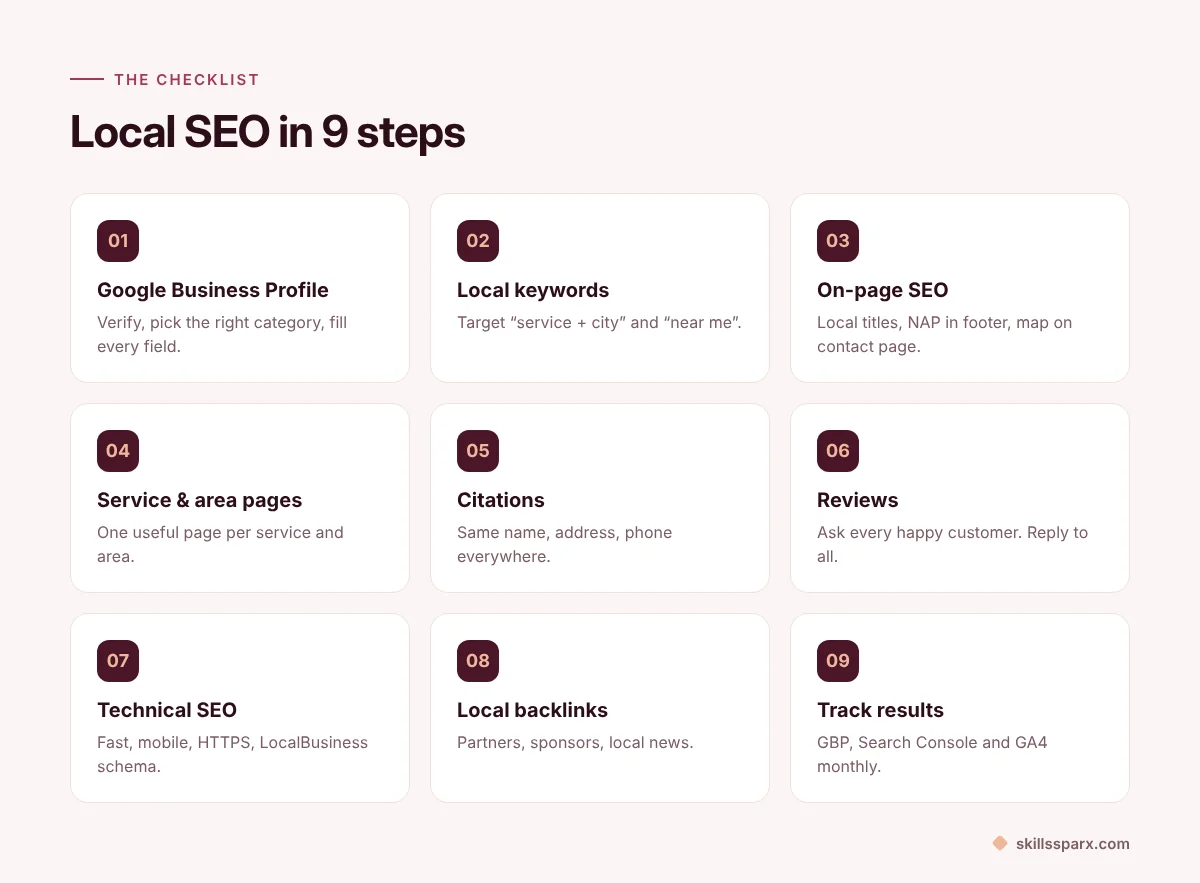
Step 1: Claim and complete your Google Business Profile
If you only do one thing from this guide, do this. Your profile is what appears on Google Maps and in the Local Pack.
- Claim and verify the profile so you control it
- Choose the most accurate primary category, e.g. “Web Designer” or “Dental Clinic”. It’s one of the strongest signals
- Fill in every field: address or service area, phone, website, hours, services
- Write a clear description of what you do and where, written for people
- Upload real photos of your premises, team and work, and keep adding new ones
- Publish posts about offers, news or recent projects so the profile looks active
Tip: use your real business name only. Stuffing keywords into the name can get the profile suspended.
Step 2: Find your local keywords
| Keyword type | Example | Where to use it |
|---|---|---|
| Service + city | website design in Lahore | Service pages, page titles |
| “Near me” | web developer near me | Google Business Profile, homepage |
| Service + area | dentist in DHA Karachi | Area pages |
| Questions | how much does a website cost in Pakistan | Blog posts, FAQs |
Google autocomplete, the “People also ask” box and Google Search Console will show you the phrases people already use. Give each page one main keyword so your pages don’t compete with each other.
Step 3: Optimise your website for local search
- Page titles with service and location: “Website Design in Lahore | Your Brand”
- Meta descriptions of about 150–160 characters that give people a reason to click
- Your name, address and phone in the footer and on the contact page
- A Google Map, opening hours and a simple form on the contact page
- Internal links between service pages, area pages and blog posts
For the full list of on-page basics, see our SEO tips guide.
Step 4: Build helpful service and area pages
Create one page per main service. If you serve several cities or areas, create a page for each, but only if you can make it genuinely useful: local projects, reviews from customers in that area, service radius and answers to local questions.
Avoid copying a page and just swapping the city name. Google treats these as low-quality “doorway” pages. For examples by industry, see how we approach plumbing websites and dental clinic websites.
Step 5: Keep your citations consistent
A citation is any online mention of your business name, address and phone number: directories, social profiles, industry sites. Use exactly the same format everywhere, down to “Street” vs “St.”, and fix old listings with outdated details. Consistency tells Google your business is real and your information is correct.
Step 6: Get reviews, and reply to every one
- Ask at the right moment: straight after a job, or when a customer says thank you
- Make it easy: send your direct review link on WhatsApp or SMS, or print a QR code
- Reply to all reviews: thank people by name, and answer complaints calmly and helpfully
- Never buy reviews or offer rewards for good ones. It breaks Google’s rules
Example reply: “Thank you, Ali! Glad the new website is already bringing in enquiries. It was a pleasure working with your team.”
Step 7: Fix the technical basics
Most local searches happen on phones, often on slow connections. A slow or awkward site sends people straight back to the map to call someone else.
- Mobile-friendly design with a click-to-call button
- Fast loading: compressed WebP images, caching, decent hosting
- HTTPS across the whole site
- LocalBusiness schema with name, address, phone, hours and coordinates
- An XML sitemap in Search Console and no broken pages
These are much easier to get right when they’re built in from the start, as part of a proper website design and development process.
Step 8: Earn local backlinks
- Partner with businesses that serve the same customers and recommend each other
- Sponsor local events, schools or sports teams that list sponsors online
- Join local business associations and chambers of commerce
- Share a useful local resource, like a cost guide, that others want to link to
A handful of links from relevant local sites beats dozens from random or spammy ones.
Step 9: Track your results every month
| Tool | What to check |
|---|---|
| Google Business Profile | Calls, direction requests, website clicks, search terms |
| Google Search Console | Clicks, impressions and positions for local keywords |
| Google Analytics 4 | Visitors, form submissions, click-to-call events |
Local SEO and AI search (AEO and GEO)
More people now ask Google’s AI Overviews, ChatGPT or Gemini for a recommendation, and these tools do suggest local businesses. To be included, your information needs to be clear, consistent and easy to quote.
- Answer first: open key sections with a one or two sentence answer
- Add FAQs with the real questions customers ask you
- Use structured data like LocalBusiness and FAQ schema
- Keep details identical across your website, profile and social pages. AI tools compare them
- Show real expertise: case studies, real photos, named people and specific facts
- Encourage detailed reviews that mention the service and area. AI summarises them
Common local SEO mistakes
- Different phone numbers or addresses on different sites
- Repeating “best plumber Lahore” until the text is unreadable
- Copy-paste area pages with only the city changed
- Ignoring negative reviews
- A slow or broken mobile site
- An inactive profile with old photos and wrong opening hours
Your local SEO checklist
| Area | Task | How often |
|---|---|---|
| Google Business Profile | Full details, right category, photos, services | Review monthly |
| Google Business Profile | Publish a post or update | Weekly |
| Reviews | Ask for reviews and reply to all | Ongoing |
| Website | Local titles, NAP in footer, map on contact page | Once, then quarterly |
| Website | Useful service and area pages | As you grow |
| Technical | Mobile, speed, HTTPS, schema, sitemap | Quarterly |
| Citations | Consistent NAP everywhere | Every 6 months |
| Tracking | GBP, Search Console, GA4 | Monthly |
Related guides: optimizing your website for AI search and mobile-friendly website design.
Final thoughts
Local SEO for small businesses isn’t about tricks. It’s about giving customers and search engines clear, accurate, helpful information about who you are, what you do and where. Start with your Google Business Profile, keep your details consistent, collect genuine reviews and make sure your website works beautifully on a phone. A little every week adds up to more calls, visits and customers.
Need a website that’s built to rank locally and turn visitors into enquiries? See our services or contact SkillsSparx.
Frequently asked questions
What is local SEO for small businesses in simple words?
Local SEO is the work you do so your business appears when people nearby search online for your products or services. It mainly involves your Google Business Profile, your website, customer reviews and directory listings.
How long does local SEO take to work?
Quick fixes, like completing your Google Business Profile, can show results within a few weeks. Stronger rankings for competitive keywords usually take three to six months of consistent work, depending on competition and location.
Can I do local SEO without a shop or office?
Yes. If you visit customers or work remotely, set up your Google Business Profile as a service-area business. You hide your address and list the cities or areas you serve instead.
Is local SEO free?
Most local SEO tasks are free, including creating a Google Business Profile, asking for reviews and improving your website content. You may pay for tools, website improvements or professional help, but you never pay Google for Map Pack or organic rankings.
How do I rank higher on Google Maps?
Choose the right primary category, complete every section of your Google Business Profile, keep your name, address and phone consistent online, get regular genuine reviews, add photos and posts, and support your profile with clear local content on your website.
Does local SEO help me appear in AI search results?
Yes. AI tools like Google AI Overviews and ChatGPT use information from websites, business profiles and reviews. Clear answers, FAQ sections, structured data and consistent business details make it easier for them to recommend your business.

Discussion